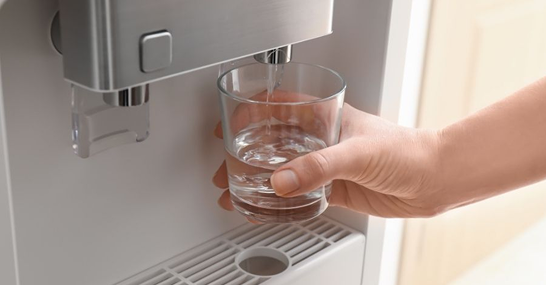
A request for a preliminary injunction against Magic Water Dispensers was recently rejected by the court. A competing company sought to immediately stop the sale and marketing of Magic’s water dispensers, claiming that the products infringed its registered designs. However, the court refused to grant the injunction, noting that there were substantial visual differences between the products and that the water dispenser market includes a wide variety of models and design styles.
In the business world, few legal tools are as dramatic as a preliminary injunction. It is an exceptional remedy that can stop commercial activity almost overnight, even before the court has fully examined the merits of the claim.
This was the situation in a recent case, where a competing company filed a request with the Magistrates’ Court seeking a preliminary injunction against our client, Magic Marketing Water Dispensers Ltd. The request aimed to prevent Magic from marketing and selling two water dispenser models that were alleged to infringe the applicant’s registered designs.
Had the request been accepted, the consequences would have gone far beyond the legal dispute itself. It could have caused an immediate halt in sales, damage to the company’s reputation, disruption to its supply chain, and significant financial harm to Magic’s ongoing business activity.
Read Our Reviews

A personal story: I ran into a small-but-urgent problem and started checking a few options on Google. Saar was the first I reached out to because of his informative content, and he replied on WhatsApp within 2 minutes. A 5-minute phone call and a two-hour wait later, what seemed like it would take months was resolved quickly and smoothly. Truly amazing. Thank you again!
At first, I was skeptical—just another lawyer making promises I doubted would be kept. Saar Gershoni proved me completely wrong. He explained exactly how to prove the copyright infringement on my video, documented everything professionally, , and the competitor removed the video and issued a written apology. He was patient and attentive despite my initial doubts, and in the end
A personal story: I ran into a small-but-urgent problem and started checking a few options on Google. Saar was the first I reached out to because of his informative content, and he replied on WhatsApp within 2 minutes. A 5-minute phone call and a two-hour wait later, what seemed like it would take months was resolved quickly and smoothly. Truly amazing. Thank you again!
The Defense: A Competitive and Saturated Market
The applicant, Tzalul Water Purification and Filtration Ltd., claimed that Magic was selling water dispensers that were highly similar to two of its registered designs, which featured an hourglass-like shape. Alongside a financial claim, the applicant also filed a request for a preliminary injunction, asking the court to prohibit Magic from continuing to market and sell the allegedly infringing products.
On behalf of Magic, attorney Raanan Ben Yishai and I argued that there were clear and meaningful differences between the products in their structure, design, and overall visual appearance. We also argued that the relevant market is highly competitive and saturated, with many water dispenser models sharing similar design characteristics.
In our position, the request for a preliminary injunction was not truly aimed at protecting a unique design, but rather at blocking legitimate competition in a market where similar design language is common. We further argued that stopping Magic’s sales would cause our client serious and disproportionate harm.
Need an Initial Consultation? Let's Talk!
Leave your details, and we'll get back to you shortly.
The Court’s Decision: Significant Visual Differences Exist
The court examined the water dispensers according to the “eye test,” a standard test in design law. This test focuses on the overall visual impression created by the product in the eyes of an informed user, rather than conducting a technical comparison of isolated details.
After reviewing Magic’s water dispensers alongside the applicant’s registered designs, the court found that while there may be some similarity between the products, there were also significant differences. These included differences in the button panel, dispensing spout, product size, visible labeling, and other visual features.
As a result, the court held that, from the perspective of the informed user, the overall appearance of the products was not identical. The claim that Magic’s products were an obvious imitation of the applicant’s designs was not proven to the required preliminary standard at this stage of the proceedings.